

This is a letter from an experienced retail controller to a store manager in her first week. The writer, the store and the figures are illustrative, but the advice is the kind usually passed on by word of mouth. It’s built around two free files: an Excel daily cash report template and a printable Word cash drawer count sheet.
Dear Priya,
Welcome to Store 4. You asked me on Tuesday what you really need to get right in your first month. My answer surprised you: the daily cash report. Not the rota, not the window displays, not even the sales targets. Those matter, but they’re forgiving. Cash isn’t. In twenty-two years of looking after money for cafés and shops, nearly every serious problem I’ve seen started as a small, unexplained number on a close-out sheet that nobody followed up.
So here’s what I’ve learned, in the order you’ll need it. I’ve attached the template we use. Last night’s close is in it as the example: Thursday 22 October, register R1, closed by Kwame.
Count the drawer by denomination, every time
Don’t count the stack and write down a total. Count each denomination, write the quantity, and let the sheet do the multiplying. Kwame’s count last night was 2 hundreds, 3 fifties, 41 twenties, 27 tens, 33 fives, 88 ones, plus coins and $10 in rolls: $1,720.04. Recording quantities matters because when the drawer is out, the breakdown shows you where. Being exactly $10 or $20 out usually means a note was miscounted or given as change by mistake. A few cents means coins. You can’t tell which it is from a single total.
Count with a witness when you can. It isn’t about trust. It protects whoever is closing, because when there’s a question, two signatures are an answer and one isn’t.
Know what should be there before you look at what is
This is the step new managers skip. They count the cash, compare it with the till’s sales figure, and get confused. The drawer was never supposed to hold just the day’s sales. The sum is:
Expected cash = opening float + cash sales + paid-ins − paid-outs
For Thursday: $200.00 float, plus $1,562.35 cash sales from the Z report, plus nothing paid in, minus $38.75 paid out to Hillside Dairy for milk (the receipt is stapled to the sheet) = $1,723.60. Take the Z-report figure, not the X report. The X report is a mid-day reading and the Z report is the end-of-day close, and mixing them up will give you a difference that isn’t real.
Over or short: the number that matters
Counted minus expected: $1,720.04 − $1,723.60 = −$3.56. The template shows this in brackets, because accountants show negatives that way, and labels it against our tolerance of ±$5.00 a day: within tolerance, note and initial.
Within tolerance doesn’t mean you ignore it. It means you write one honest line about it. Kwame’s note reads: “Short $3.56, likely a change error during the 12:00–13:00 rush; no voids or no-sales flagged on the Z report.” That’s all I need. A plausible cause, plus a check that rules out anything worse.
If it’s outside tolerance, the cell turns red and says recount, then call the manager. Do it in that order. Most big differences go away on a recount: a bundle of twenties counted as tens, or a $50 tucked under the tray. The ones that don’t go away are the ones we need to talk about the same evening, not next week.
And be just as wary of being over. A drawer that’s $20 over usually means a customer was short-changed, or a sale was rung up for less than was taken. Over isn’t good news. It’s an error going the other way.
The float is not yours to spend
The $200 float stays in the drawer for tomorrow’s opening, every night, in the same mix of notes and coins. It isn’t change for the staff coffee run and it isn’t a petty cash tin. The deposit is counted cash minus the float: $1,720.04 − $200.00 = $1,520.04, sealed in bag B-20418 with deposit slip 7735 at 19:14. Write both numbers on the sheet. When the bank credits $1,520.04 on Monday, the bookkeeper will tick it off against your bag number. If the bank says it received $1,500.04, the bag number is how we find out where the $20 went.
Pay for supplies from the drawer only with a receipt, and record every one as a paid-out. A paid-out without a receipt is a shortage.
Reconcile the cards too
Section 4 of the report compares each tender with what the POS says. Card sales per POS were $3,284.90, and the card terminal’s batch settlement (batch #3381) was also $3,284.90. A difference there means a transaction went through on the terminal but not the till, or the other way round. It’s usually a refund keyed in one place and not the other. Gift card redemptions get checked the same way. Total sales for Thursday were $4,911.25, and the only difference anywhere was the $3.56 in cash.
Why I care about $3.56
I don’t care about the money. I care about the pattern. That’s what the second tab of the workbook is for: an October log with one row per day, showing cash sales, over/short, a running total and a flag. Here’s what Store 4 looks like this month:
- 22 days counted, 8 of them balanced to the cent.
- One day outside tolerance, Sunday 11 October at −$24.80. It was investigated. A refund had been given in cash for a card purchase.
- Net for the month: −$30.46, or about 0.11% of cash sales.
That’s a healthy store. Small differences that go both ways are normal, because people make change by hand. What worries me is different: shortages every day that are always under the tolerance, shortages that keep landing on the same person’s closes, or a running total that only ever goes down. You’ll only see those patterns if every day goes in the log. One sheet on its own looks fine.
The paper sheet still earns its place
I know you’ll do most of this on the laptop. Keep the printed count sheet in the drawer anyway. When the laptop is dead, the Wi-Fi is down or the closer is on their own at 22:00, the paper version means the count still gets done properly. It has denomination boxes on the left, the reconciliation on the right, and space for paid-outs, the bag number and three signatures. File it with the Z report and the receipts. If we’re ever audited, that envelope is the evidence.
Talk soon. Ring me after your first outside-tolerance day. Everyone has one.
Ruth
Retail controller
Count the drawer here first
If you’re closing up and the template isn’t open yet, count by denomination below. It works out expected cash and over/short the same way: float plus cash sales plus paid-ins minus paid-outs.
Counted = Σ count × denomination (done in cents, so no rounding drift). Expected = opening float + cash sales + paid-ins − paid-outs. Over/short = counted − expected.
The Excel daily cash report template
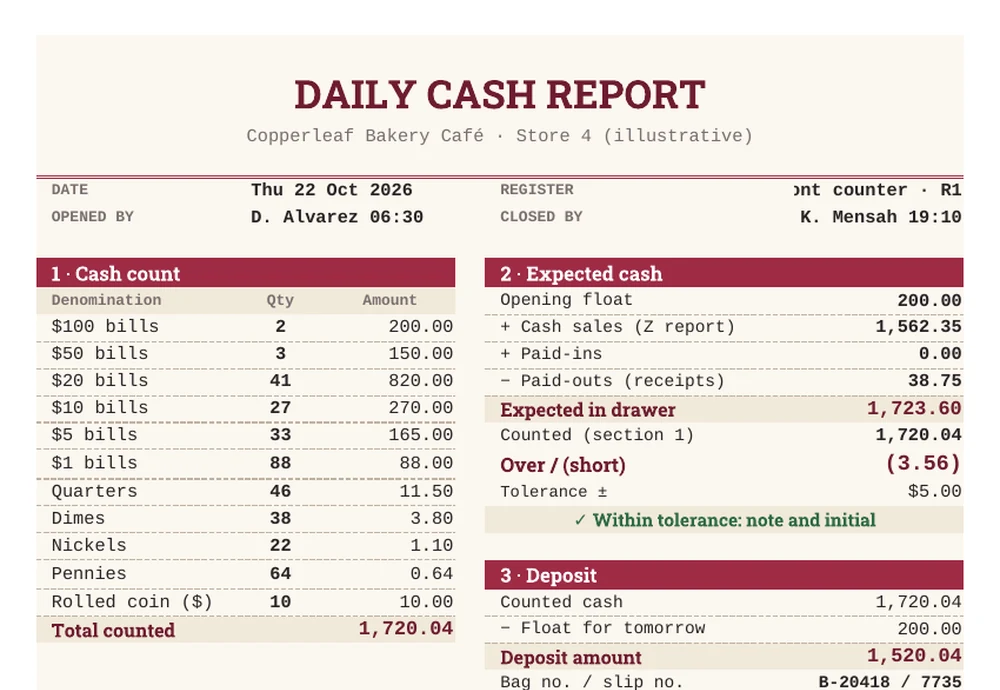
The first tab is the nightly report in four numbered sections: cash count, expected cash, deposit, and other tenders. You type the quantities and the Z-report figures, and the formulas calculate the totals, the over/short against your tolerance and the deposit amount. Change the float and the tolerance to suit your store. The second tab is the monthly over/short log, with a running total, an INVESTIGATE flag for any day outside tolerance, and a summary of days balanced, days flagged and shortage as a percentage of cash sales.
The Word cash drawer count sheet
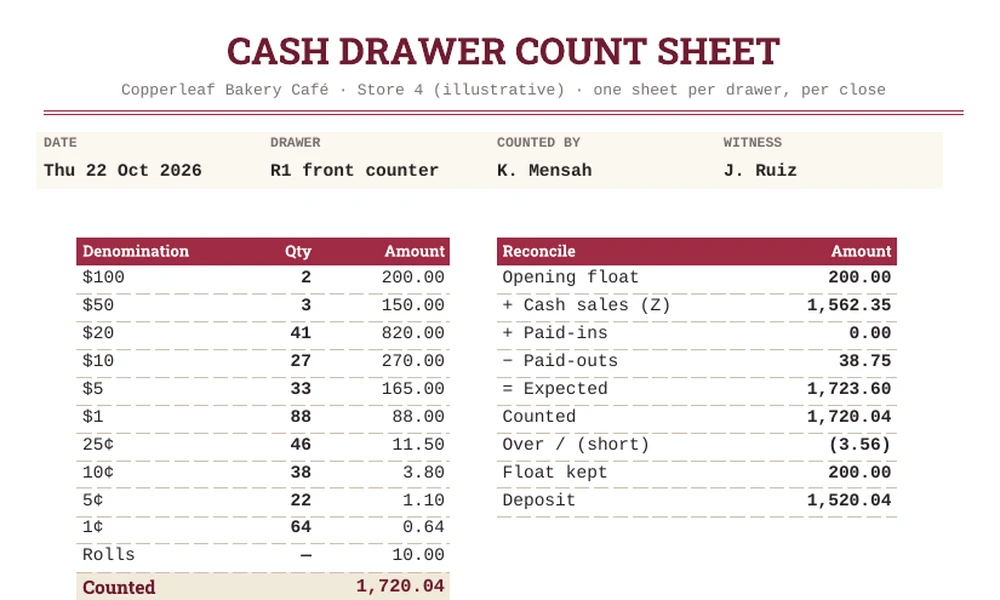
This is the one-page paper version for each drawer and each close, filled in with Thursday’s figures so you can see how a finished sheet looks. Print a stack with the figures cleared, and keep it in the drawer.
Where the daily cash report fits
The cash report proves the drawer. The daily sales report explains the sales: what sold, when, and against which target. The deposits you record here are what you’ll tick off in the monthly bank reconciliation. If your stores run shift handovers, cash counts can go in the end of shift report as well, but the sheet with the signatures should stay with the cash.
Ruth, Priya, Kwame, Copperleaf Bakery Café and all figures are illustrative. Set your own float, tolerance and escalation rules with your accountant or finance team.

