

Petty cash is the money nobody wants to think about. It’s usually a tin in a drawer with a few hundred dollars and a pile of crumpled receipts. Once a month someone tries to work out why it’s $14 lighter than it should be. It also attracts a surprising amount of folklore, and most of that folklore is why the tin keeps coming up short.
Below are six things people believe about petty cash that turn out to be wrong, with what to do instead. After that you’ll find two free petty cash templates. One is an Excel log that keeps a running balance and walks you through a month-end cash count. The other is a one-page Word report that asks for the top-up and gets it signed off.
Myth 1: “It’s too small to bother tracking properly”
A $300 float doesn’t sound like much. But if it’s topped up twelve times a year, that’s $3,600 or more flowing through a box with less control than a $40 supplier invoice. Fraud examiners keep finding the same thing: small organizations lose a bigger share of their money to internal theft, mainly because one person often handles everything with nobody checking. Petty cash is a textbook example.
The fix isn’t a big procedure. It’s a log with a line for every payment, a voucher number for every line, and a second person who looks at it once a month. That’s all the Excel template asks for.
Myth 2: “Top it up whenever it runs low”
This is the most common mistake, and it causes most of the confusion. When the box gets topped up with “another $100” or “whatever the bank gave us”, the fund drifts. After a few months nobody knows what the right balance should be.
The standard approach is called the imprest system, and it’s simple. Decide on a fixed amount, called the float (say $300). At the end of each period, count what’s left, and top up by exactly what’s missing. Spend $229.58 and you get back $229.58, plus or minus any small over/short. Afterwards the box is back to $300 again. At any moment, cash plus receipts should equal the float. That makes any problem show up straight away.
Myth 3: “No receipt means it can’t go in the log”
Some purchases don’t come with a receipt: a parking meter, a tip, a market stall. Sometimes the receipt simply gets lost. Leaving the payment out of the log is the worst response, because the money is gone either way and now the records are wrong.
Write a voucher instead. It should show the date, amount, who was paid, what it was for, and a signature from whoever approved it. The template has a Receipt? column that turns terracotta when you choose “No”, so missing receipts stand out at review time instead of hiding. For US tax purposes, IRS rules generally don’t require a receipt for travel, meal or gift expenses under $75 (lodging aside). You still need a written record of the amount, date, place and business reason. A good voucher covers that.
Myth 4: “Petty cash and expense reports are the same thing”
They solve different problems. An expense report pays back an employee who spent their own money. Petty cash is the company’s money, handed out in advance. Mix them up, for example by repaying an expense claim out of the petty cash tin, and both sets of records stop making sense.
A rough rule: small, frequent, cash-only purchases go through petty cash. Anything bigger, anything paid by personal card, and anything involving travel goes through an expense report. Trips have their own travel expense report with per-diem and mileage lines.
Myth 5: “If it’s short, someone took it”
Sometimes they did. Much more often it’s change given wrongly at a till, a coin dropped behind the drawer, or a $2.00 purchase written down as $2.50. A cash fund that balances to the cent every single month is unusual, and a bit suspicious.
Set a tolerance and write it down. The template uses $1.00. When the over/short is within that, note it and move on. When it’s over, the sheet tells you to recount and check vouchers before topping up. In the sample month, the fund came out $0.25 short. That gets recorded, and nobody needs to get upset about it.
Myth 6: “A bigger float means fewer hassles”
A bigger float means fewer top-ups, but more cash sitting in a drawer. It also makes a missing $50 easier to miss. Size the float to cover about a month of normal spending, then look at it again after three months. If you’re topping up every week, it’s too small. If last month’s spending was $40 out of a $500 float, it’s too big.
The Excel petty cash log
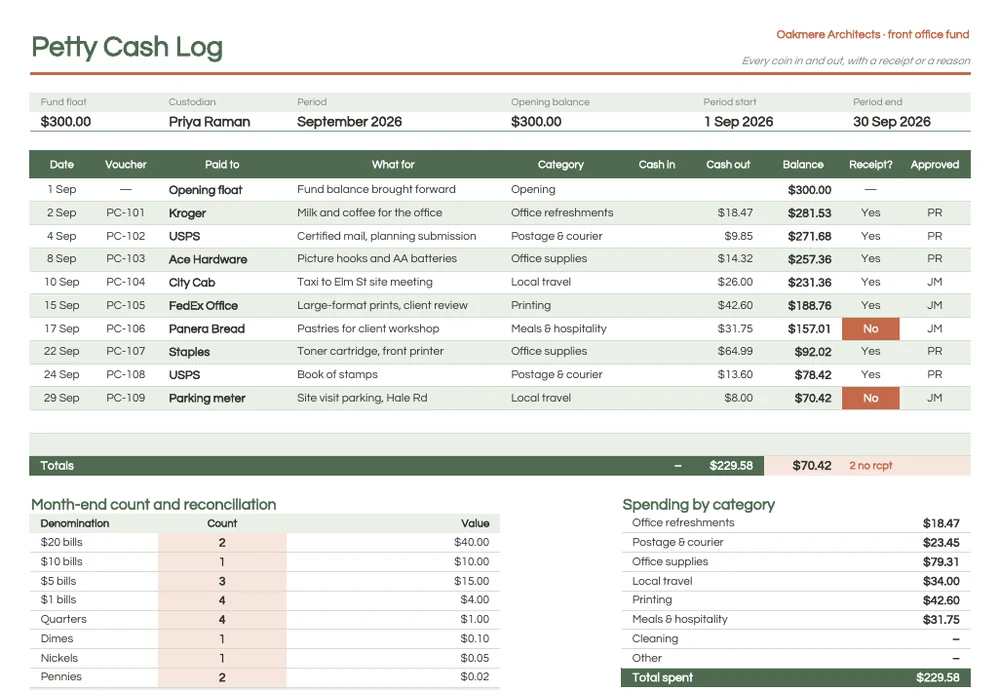
The sample month belongs to the front office at a small architecture practice. It shows nine payments, from $8.00 for a parking meter to $64.99 for a toner cartridge, and every line updates the running balance. The tab also includes:
- A category drop-down, so spending can be added up and posted to the right expense accounts.
- A denomination count. Type how many of each bill and coin are in the box and it totals the cash for you. That’s much faster than counting it twice by hand.
- Over/short and top-up lines that work out the replenishment needed to restore the float.
- A category summary with a check that it matches the log, so an uncategorized line can’t slip through.
Start a new copy each month, or clear the payment rows and change the period dates. The opening balance comes from the float, which is how an imprest fund should behave.
Here’s how Oakmere’s September reconciles, line by line. It’s the same arithmetic the sheet does for you:
| Step | Amount | Where it comes from |
|---|---|---|
| Float at the start of the month | $300.00 | Fund float cell |
| Less: nine payments | ($229.58) | Sum of the Cash out column |
| Should be in the box | $70.42 | Last running balance |
| Actually counted | $70.17 | Denomination table |
| Over / (short) | ($0.25) | Counted minus expected |
| Top-up to restore the float | $229.83 | Float minus cash counted |
Notice that the top-up is worked out from the cash actually counted, not from the receipts. That way the shortage is absorbed and recorded, rather than carried forward into October where it would get mixed up with next month’s spending.
The Word petty cash report
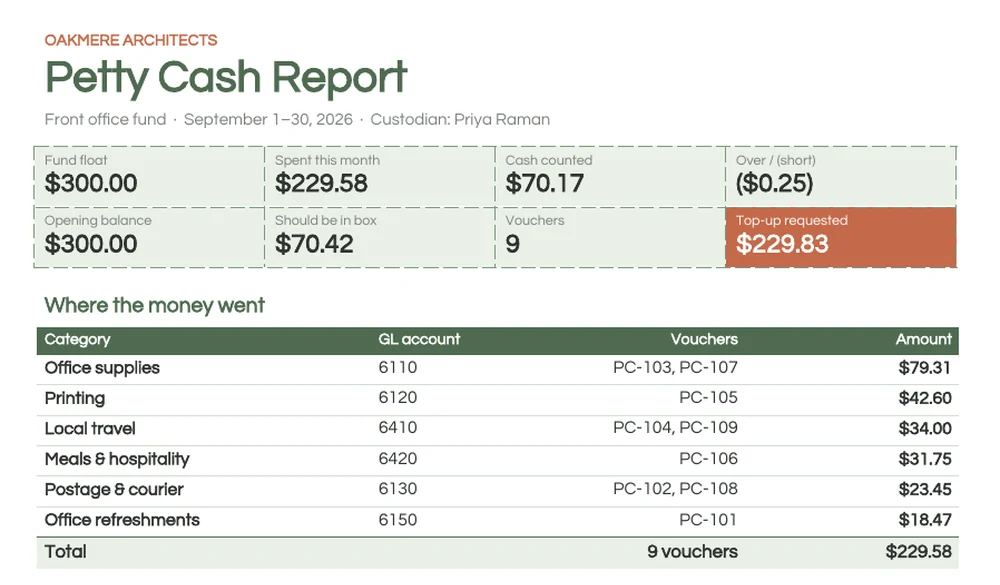
This is the page that goes to whoever writes the check. It covers the whole month in eight boxes, then lists spending by category with the account each one posts to. Next is an exceptions section that explains the two missing receipts and the 25-cent shortage, followed by a one-paragraph replenishment request and signature lines. Staple the vouchers behind it and the month is closed.
Setting up a fund from scratch
- Pick one custodian. One person responsible, not “whoever’s at the front desk”.
- Set the float, write a check for it, and record it as a petty cash asset in your books.
- Agree what petty cash can be used for and an upper limit per payment ($50 or $75 is common).
- Keep the tin locked and the log next to it. Log each payment as it happens, not at month end.
- Once a month, count, reconcile, fill in the report, and get a second signature before topping up.
- Every so often, do a surprise count. It takes two minutes and it keeps everyone honest.
None of this needs software. It just needs the same small routine every month, and two templates that make the routine quick.