
Most small-business owners meet the balance sheet the hard way. A bank asks for one with a loan application, or an accountant sends one over at tax time and nobody quite knows what to do with it. It’s the financial statement people feel they ought to understand and rarely get the chance to learn properly.
This page works through the questions owners actually ask, in roughly the order they ask them. Along the way it uses a real-looking example: Fernhill Outdoor Supply, a small camping and outdoor-gear shop, as of September 30, 2026. Both balance sheet templates used here are free. One is an Excel workbook that compares two dates and works out the key ratios. The other is a one-page Word statement you can hand to a lender.
What is a balance sheet, in one sentence?
It’s a snapshot of everything a business owns, everything it owes, and what would be left for the owner if every debt were paid off today.
The key word is snapshot. A profit and loss statement covers a stretch of time, like a month or a year. A balance sheet is one moment. Fernhill’s balance sheet says “as of September 30, 2026”. On October 1 it would already be slightly different.
Why does it have to balance?
Because every dollar the business holds came from somewhere. Either someone lent it (a liability) or it belongs to the owner (equity). That gives the equation the whole statement rests on:
Assets = Liabilities + Owner’s Equity
For Fernhill, that’s $238,230 of assets = $124,640 of liabilities + $113,590 of equity. If the two sides don’t match, something has been left out or entered twice. It doesn’t mean the business is in trouble. It means the bookkeeping is.
What goes on each side?
There are three groups, and each one is split by timing. Anything “current” turns into cash, or has to be paid, within a year.
| Section | Typical lines | Fernhill, Sep 30 |
|---|---|---|
| Current assets | Cash, accounts receivable, inventory, prepaid expenses | $161,880 |
| Fixed assets | Equipment, vehicles, property, less accumulated depreciation | $72,850 |
| Other assets | Security deposits, long-term investments | $3,500 |
| Current liabilities | Accounts payable, credit cards, accrued wages, sales tax, the next 12 months of loan payments | $55,640 |
| Long-term liabilities | Bank loans (beyond 12 months), loans from the owner | $69,000 |
| Owner’s equity | Capital put in, retained earnings, this year’s profit, minus owner’s draws | $113,590 |
Two lines tend to confuse people. Accumulated depreciation is shown as a negative number under fixed assets. It’s the share of the equipment’s cost that has already been “used up” on paper. Current portion of the bank loan is the $12,000 of principal due in the next twelve months. It moves out of long-term debt and into current liabilities, because that’s money the business needs to find this year.
Where do I get the numbers?
If you use accounting software, it will produce a balance sheet on its own, so this template is mostly for checking, presenting or comparing. If you keep books in a spreadsheet, or haven’t kept them at all, the numbers come from places you already have:
- Cash: the closing balance on every business bank statement for that date, after reconciling.
- Accounts receivable: unpaid customer invoices. Your AR aging list, if you keep one.
- Inventory: a stock count valued at what you paid, not what you’ll sell it for.
- Fixed assets: purchase receipts and your depreciation schedule (your accountant will have one).
- Liabilities: unpaid supplier bills, credit card statements, loan statements, payroll owed but not yet paid, and sales tax collected but not yet sent.
- Equity: what the owner put in, plus profits kept in the business over the years, minus what the owner took out.
How do I fill in the Excel template?
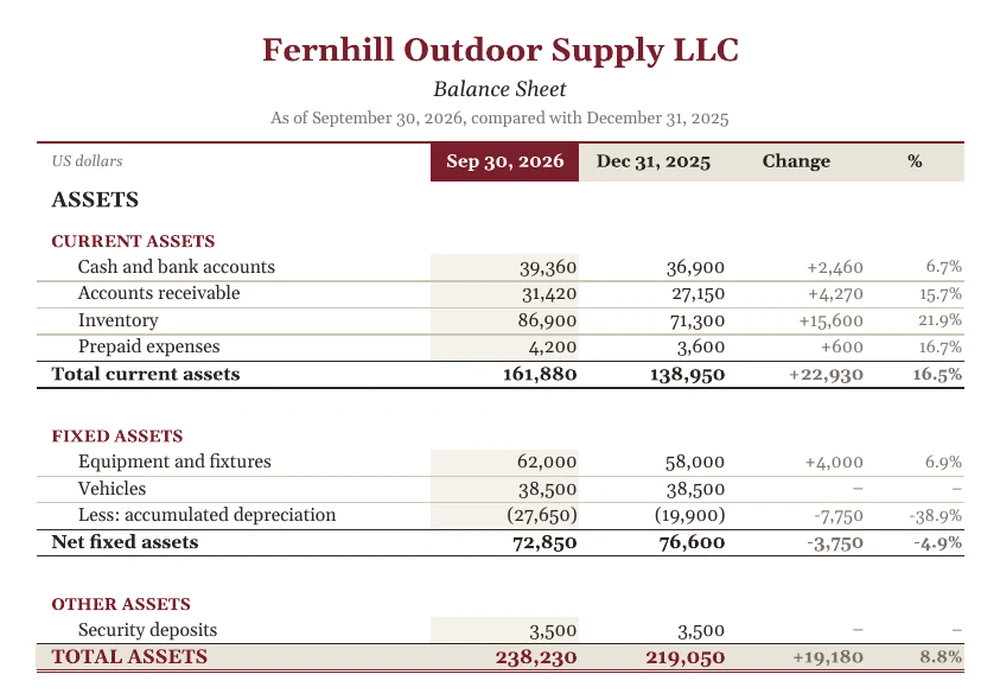
Type your figures into the shaded column for the current date, and last year-end’s figures into the column next to it. Every subtotal, total, dollar change and percentage change is a formula. So is the check line at the bottom. It turns green and says Balanced when assets equal liabilities plus equity, and red with the size of the gap when they don’t.
Rename, add or delete lines freely. The subtotals are simple SUM ranges, so inserting a row inside a section keeps it included. Enter negatives (depreciation, draws) with a minus sign and they’ll display in brackets the way accountants expect.
The second tab, Ratios, reads straight from the balance sheet and writes a plain-English sentence next to each result. You never type on it.
What should I look at once it’s done?
A balance sheet becomes useful when you compare it with an earlier one and run a few ratios. Here’s what Fernhill’s tells us:
| Measure | Sep 30, 2026 | Dec 31, 2025 | Reading |
|---|---|---|---|
| Working capital | $106,240 | $90,240 | More short-term cushion than at year end |
| Current ratio | 2.91× | 2.85× | Healthy: almost $3 of current assets per $1 due this year |
| Quick ratio | 1.27× | 1.31× | Can pay current bills without selling stock, but only just |
| Inventory share of current assets | 54% | 51% | Over half the cushion is gear on shelves |
| Debt to equity | 1.10× | 1.37× | Debt falling relative to owner money |
The headline looks reassuring: a current ratio near 3, and debt shrinking as the loan is paid down. The detail is more interesting. Inventory jumped $15,600 (22%) since December, while cash rose only $2,460. For an outdoor shop heading into autumn, some of that is seasonal stock. But if winter gear doesn’t sell, more than half of Fernhill’s “healthy” working capital is tied up in tents and jackets. That’s the kind of insight a balance sheet gives you that a sales report never will.
Accounts receivable rising 16% is the other thing worth a look. A shop with trade customers and team accounts should check who’s paying slower than before.
How is this different from a P&L or a cash flow statement?
The three statements answer three different questions, and they connect to each other:
- The profit and loss statement asks did we make money over this period? Fernhill’s $39,250 year-to-date net income comes from there and lands in equity on the balance sheet.
- The cash flow statement asks where did the cash actually go? It explains why cash rose only $2,460 when profit was $39,250. Inventory, receivables, loan payments and owner’s draws absorbed the rest.
- The balance sheet asks where do we stand right now?
If you need all three in one pack for a lender or investor, our financial report template pulls them together with a short commentary page.
What’s the Word version for?
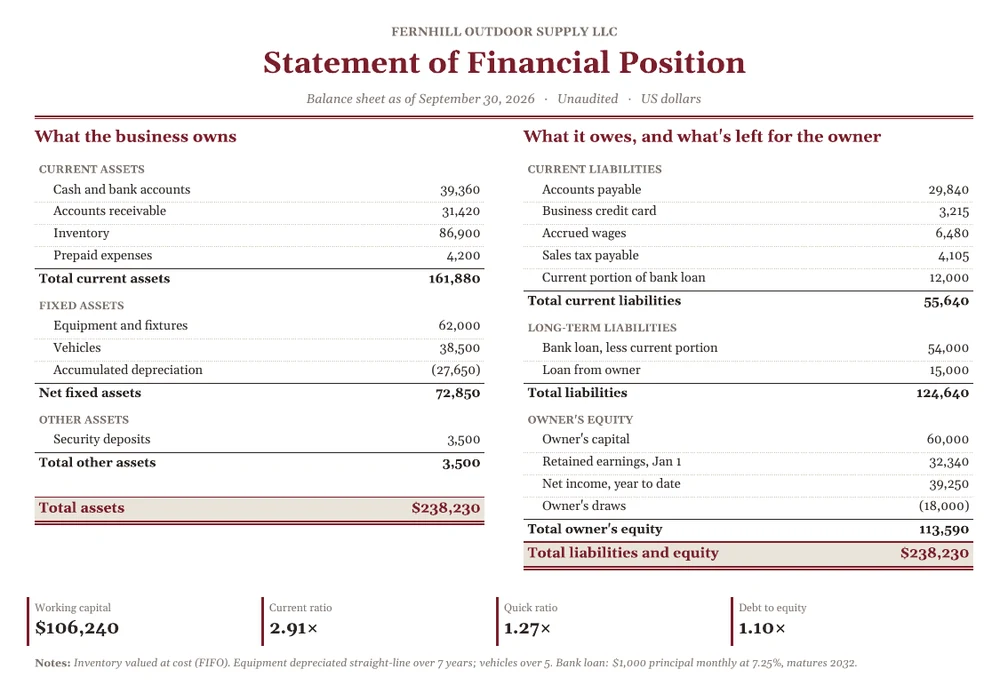
This is the version you send, not the one you work in. It uses the “account form” layout, with assets on the left and liabilities and equity on the right, so the balance is visible at a glance. Below that is a strip of four ratios, short notes on how inventory and assets are valued, and a sign-off line. Banks often want exactly this: one page, a clear date, the word “unaudited” if it is, and the owner’s name on it.
Update the numbers by typing over them. Keep the Excel file as your working copy, so the arithmetic is checked before anything goes into the Word statement.
How often should a small business prepare one?
At minimum, once a year at year end, because your tax preparer needs it. Quarterly is better for most businesses that carry inventory or debt. Monthly makes sense if you’re managing a credit line, growing quickly or trying to fix a cash problem. The Excel template’s comparison column works for any of these. Put the previous period’s figures in column D and the changes follow.
What if it doesn’t balance?
Check these in order. Between them they cover nearly every case:
- Is this year’s profit in equity? Leaving out year-to-date net income is the most common reason for a gap.
- Are owner’s draws entered as a negative? A positive $18,000 creates a $36,000 error.
- Did you double-count the loan? The current portion should come out of the long-term figure, not sit in both places.
- Is depreciation negative? Same sign problem as draws.
- Are both dates really the same date? A bank balance from October 2 mixed with a payables list from September 30 won’t match.
- Is the gap divisible by 9? If so, look for two transposed digits, such as 3,215 typed as 3,125.
Once it balances, save a copy with the date in the filename. Next quarter, that copy becomes your comparison column, and the balance sheet starts telling you a story instead of just giving you a total.