

Most end-of-shift reports are written for the wrong reader.
They’re written for the manager who’ll skim them later in the week, so they open with headcount and output and bury the useful part somewhere around line fourteen. But the person who actually needs the report is standing in front of you at 6:30 in the morning with a coffee, about to take over your floor. They have ten minutes before their shift starts, and they need to know what’s broken, what’s late and what could hurt someone.
Write for that person and almost everything else about the report sorts itself out. That’s the whole argument of this piece. There’s a free end of shift report template further down, a one-page Word handover sheet and an Excel version with a weekly log, both built around that idea.
A handover that went wrong in eleven words.
Here’s a version of a story most shift supervisors could tell.
A night supervisor at a distribution center has a rough shift. A conveyor jams just before midnight. Around two, a forklift starts leaking hydraulic fluid near the mast; it gets tagged out and parked. The Wi-Fi in one zone drops and the scanners go with it. The crew still ships most of what it should.
At the end of the shift the supervisor writes a thorough report. Headcount, orders shipped, units picked, trucks loaded, three downtime events with times, two near misses, a first-aid case. Halfway down the downtime table, in eleven words: FL-07 hydraulic leak by mast, tagged out, maintenance ticket raised.
The morning lead reads the top of the report. Output’s a bit down, nobody was seriously hurt, fine. At 6:45 they hand out trucks. The tag on FL-07 is on the side facing the wall, and a driver takes it. Twenty minutes later there’s a slick of fluid down an aisle, the aisle is closed for cleanup, and the trailer that was supposed to leave at eight leaves at nine.
Nobody did anything wrong, exactly. The information was in the report. It was just in the wrong place.
Put three things at the top, and only three.
The fix is simple, and it’s the single design choice everything in the template follows: the first section of the report is the handover. Not the date block, not the numbers. Three lines, written as instructions to the next shift:
- What’s broken or unsafe, and what they should do about it. FL-07 is tagged out. Do not use it. Parts due at 10:00.
- What’s late or at risk. Ashford batch 7 is picked and staged in lanes D4 to D6 but not loaded. Their carrier comes at 08:00. Load it first.
- What might happen again, and who to call. Zone D Wi-Fi dropped twice. If it drops again, call IT on-call, not the help desk.
Why three? Because a list of seven is a list nobody remembers, and because forcing yourself to choose is the useful part. If something doesn’t make your top three, it goes in the open-issues table further down, where it’s still recorded but isn’t competing for attention.
Write each line so it would make sense to someone who wasn’t there and didn’t read anything else. Equipment ID, location, what to do, when it changes. Leaked fluid near the mast on FL-07 is a fact. Do not use FL-07 is a handover.
Numbers come second, and never on their own.
I’m not against numbers. A shift report without them is just a diary. But a number without a target is trivia, and a number below target without a reason invites the wrong conversation.
So every output line in the template has a target, an actual, the percentage of target and a short note. Here’s the night from the story:
| Measure | Target | Actual | % of target | Note |
|---|---|---|---|---|
| Orders shipped | 1,850 | 1,712 | 92.5% | Ashford batch 7 carried over |
| Units picked | 24,000 | 22,940 | 95.6% | Lost about 45 min of reach-truck time |
| Trucks loaded | 14 | 13 | 92.9% | Ashford trailer goes at 08:00 |
| Inbound trailers unloaded | 9 | 10 | 111.1% | Took one early arrival |
| Pick accuracy | 99.70% | 99.82% | 100.1% | 4 mis-picks caught at pack |
Read the notes column and the shortfall stops looking like a slow crew. It’s one forklift and one carrier booking. That’s a very different Monday meeting.
The Excel version also works out labor hours (people on shift × 8, plus overtime) and units per labor hour, which came to 65.4 against a target of 70. Downtime minutes are calculated from start and end times, including stops that run past midnight, which is exactly where hand-typed minutes tend to go wrong.
What’s in the free template.
Start with the Word handover sheet. It’s one printed page, designed to be read at the start of the next shift with both supervisors standing at the desk. The handover is section one, in a box you can’t miss.
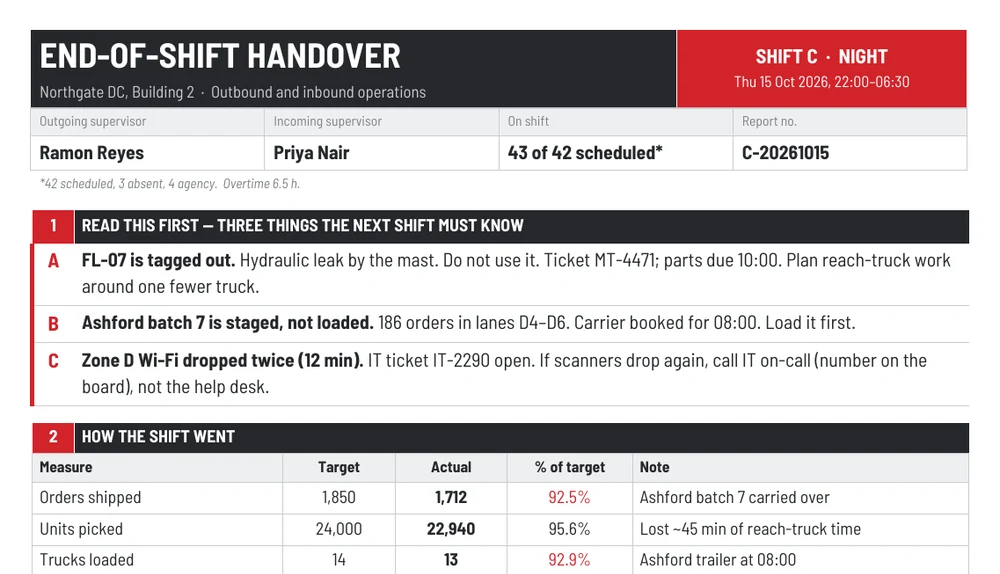
Below the top three it has the shift numbers with notes, a safety strip (recordable injuries, first aid, near misses, days without a recordable), an open-issues table with priority, owner and due time, a short before-you-leave checklist and two signature lines: one for the outgoing supervisor, one for the incoming supervisor to confirm they’ve read it.
The Excel template carries the same structure, plus the arithmetic:
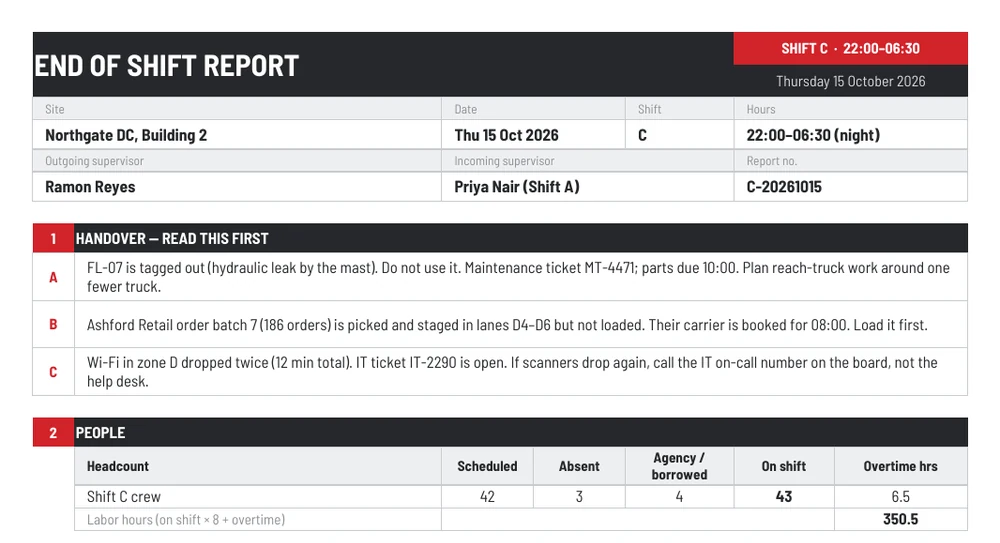
- Shift Report tab: people on shift, output against target with a status that flags anything under 95% as Behind, a downtime log that totals minutes and counts unfixed equipment, safety counts, open issues with drop-down priorities and statuses, and a line that counts open and high-priority items automatically.
- Week Log tab: one row per shift, three shifts a day for a week. The current shift’s row pulls straight from the report, and the week-to-date line shows total orders against target, total downtime and safety counts. In the sample, the week is running at 95.3% of target, and Thursday night stands out with 102 minutes of downtime.
Rename the measures to fit your operation. A hospital ward, a security desk, a hotel front office and a production line will each track different things. The order of the sections is the part worth keeping.
Ten minutes, not forty.
If writing the report takes forty minutes, it gets written badly or not at all, usually in the car park. A few habits keep it short:
- Write as you go. Log downtime and incidents when they happen, with times. At the end of the shift you’re only writing the top three.
- Write the handover last. By 6:15 you know which of the night’s problems are still problems.
- Hand it over in person. Walk the incoming supervisor through the three lines, then both sign. The signature isn’t bureaucracy. It’s the moment the next shift accepts the floor as it is.
- Don’t copy yesterday’s report. Stale open issues are worse than none, because people learn to skip the section.
The report doesn’t end at the handover.
Once the shift has been handed over, the same page feeds everything else. Anything that hurt someone or nearly did belongs in a proper incident report, not just a line on the shift sheet. Equipment that keeps showing up in the downtime log is a case for the maintenance report. Absences and agency cover roll into an attendance report, and the week log gives you most of what a KPI report or a broader daily report needs without re-keying anything.
But all of that comes second. The first job of an end-of-shift report is to make sure the next person walks onto a floor they understand. If your report does that, it’s a good report, whatever else is on it.

