

Shift change is the most dangerous fifteen minutes on a ward. Everything one nurse knows about a patient has to reach the next nurse, out loud, usually while call lights are going off. A good nursing shift report makes that transfer short, complete and the same every time.
This page is a field guide, not an essay. It gives you two free templates: an Excel handoff board for the whole assignment and a one-page Word SBAR sheet for each patient. Then it covers how to use them at the bedside: an SBAR cheat sheet, a sample 60-second script, and the phrases worth dropping.
A note before you start: the templates are for organizing handoff information. They don’t replace your facility’s policies, approved forms or clinical judgment. All patients in the samples are fictional.
The two templates at a glance
| Excel handoff board | Word SBAR sheet | |
|---|---|---|
| Covers | Whole assignment (up to 8 patients) | One patient |
| Best for | Charge nurses, start-of-shift planning | Bedside report, transfers, float staff |
| Calculates | NEWS2 score, risk band, fall risk, net I&O | Nothing; it’s a structured form |
| Prints on | One landscape page | One portrait page |
Template 1: the Excel handoff board
Vitals & Scores tab. Enter the latest respiratory rate, SpO2, whether the patient is on oxygen, temperature, systolic blood pressure, heart rate and level of consciousness (ACVPU). The sheet works out each NEWS2 sub-score and the total. Sub-scores of 2 turn amber and 3 turn red, so you can see which vital sign is driving the score. The same tab takes the Morse Fall Scale score and intake and output, and returns net balance.
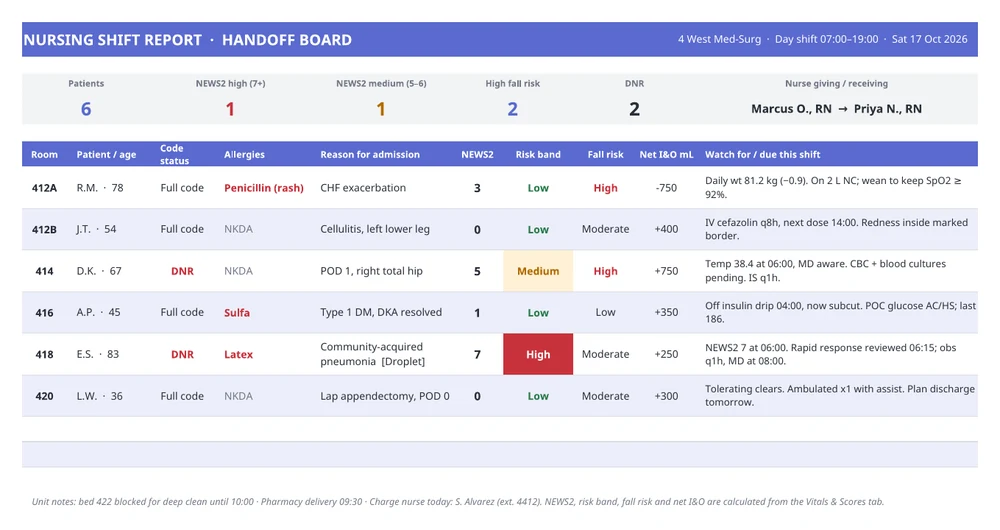
Handoff Board tab. One row per patient: room, initials and age, code status, allergies, reason for admission, and a free-text “watch for / due this shift” column. NEWS2, risk band, fall risk and net I&O come across from the other tab. The tiles at the top count high and medium NEWS2 scores, high fall risks and DNR orders, which is the first thing a charge nurse wants at 06:55.
In the sample, the board shows six patients on a fictional 4 West med-surg unit. Room 418, an 83-year-old with pneumonia, shows NEWS2 7 in red. The note says rapid response has already reviewed her. Room 414, a first day post-op hip, scores 5 because of a new fever and a heart rate of 104. Everyone else is low. A receiving nurse can see in ten seconds where to go first.
About the NEWS2 calculation: the scoring follows the Royal College of Physicians NEWS2 chart (SpO2 scale 1). Bands are 0–4 low, 5–6 medium and 7 or more high, and any single parameter scoring 3 makes the patient low-medium. If your hospital uses a different early warning score, or SpO2 scale 2 for patients with hypercapnic respiratory failure, change the formulas or ignore the column.
Template 2: the Word SBAR sheet
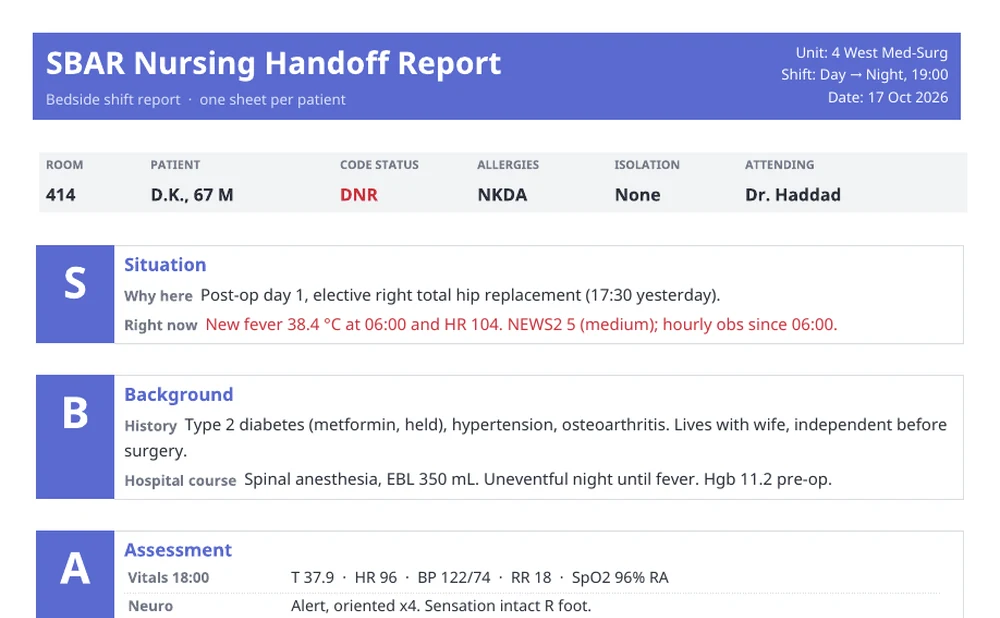
One page per patient. The ID strip at the top shows room, patient, code status, allergies, isolation and attending, so the safety-critical details come first. Then four blocks:
- S: why they’re here and what’s happening right now, in two lines.
- B: relevant history and how the stay has gone so far.
- A: latest vitals and a body-systems grid (neuro, resp, cardio, pain, GI/GU, skin, lines), plus one line for your own concern.
- R: tick boxes for what’s due, what’s pending and who needs a call.
The bottom strip records who gave and received report, the time, and what was checked together at the bedside. The sample is filled in for the hip patient in room 414 at the evening handoff, so you can see how much fits on a page.
SBAR cheat sheet
Print this, or keep it on your badge card.
| Letter | Say | Keep it to |
|---|---|---|
| S · Situation | Who, where, why they’re here, and what’s going on right now | 1–2 sentences |
| B · Background | Relevant history, procedures, course so far, code status, allergies | 3–4 facts that change care |
| A · Assessment | Latest vitals and trends, abnormal findings by system, your read of the situation | Abnormal first, then “rest WNL” |
| R · Recommendation | What’s due, what’s pending, what to watch for and when to escalate | Clear actions with times |
SBAR started in the US Navy and was adapted for healthcare at Kaiser Permanente in the early 2000s. It works because the listener knows what’s coming next and can tell when something is missing.
A 60-second handoff, out loud
Here’s room 414 from the sample, as it might sound at the bedside:
S: This is D.K., 67, day one after an elective right hip replacement. He’s DNR, no known allergies. He spiked 38.4 at six this morning with a heart rate of 104, so he’s been on hourly obs.
Bedside report, room 414 (illustrative)
B: Type 2 diabetic, metformin held, hypertensive. Spinal, blood loss 350, uneventful night until the fever.
A: Last set at 18:00 was 37.9, 96, 122 over 74, satting 96 on room air. Bases are diminished and he’s only pulling 750 on the spirometer. Dressing’s dry, pulses good, pain 4 out of 10. I think it’s more chest than wound.
R: Recheck temp and heart rate at 20:00, and call if he’s 38.5 or over or scores 5 again. CBC was 11.8, MD aware, cultures pending. Push the spirometer. His wife calls at 8:30 and he’s happy for us to update her.
Time it. If you’re well past a minute for a stable patient, you’re probably reading out normal findings one by one.
Say this, not that
| Instead of… | Say… |
|---|---|
| “He had a rough night.” | “He was up at 02:00 and 04:00 with pain 7/10, settled after oxycodone.” |
| “Vitals are fine.” | “Last set 18:00: 37.9, 96, 122/74, RR 18, 96% on room air, trending down.” |
| “Labs are pending.” | “Blood cultures sent 07:10, check in the morning.” |
| “Keep an eye on her.” | “Call if her NEWS2 is 5 or more or she needs more than 2 L.” |
| “Family’s difficult.” | “Daughter wants a call before any plan changes; her number is on the board.” |
The pattern: numbers instead of adjectives, times instead of “earlier”, and a clear trigger instead of “watch”.
Bedside checklist
Do these with the patient, not at the desk:
- Check the ID band against the sheet.
- Confirm code status and allergies out loud.
- Trace IV lines from bag to patient; check pump rates against orders.
- Look at wounds, drains and pressure areas together.
- Check the call light is in reach and the bed alarm is on for high fall risk.
- Ask the patient: “Is there anything you want your night nurse to know?”
- Sign the handoff strip with the time.
Bedside handoff can feel slower at first. But it catches things a desk report won’t: a pump running at the wrong rate, a dressing that’s soaked through, or a patient who has gone quieter since lunch.
Common gaps the template is designed to close
- Pending results that no one owns. The R block forces a line for each one, with a time to check.
- Code status buried in background. It sits in the ID strip and on the board, in red when it’s DNR.
- “Fine” with no numbers. The assessment block asks for the actual last set of vitals and a trend.
- Escalation by feel. NEWS2 on the board gives both nurses the same number to talk about.
If something does go wrong on shift, such as a fall, a medication error or a near miss, document it separately using your facility’s process. For a general format, see the incident report template. For full clinical summaries, rather than handoff notes, the medical report templates are a better fit.
Adapting the templates
- Other units: rename the body-systems rows. ICU might add a ventilator and drips row, maternity might add fundus and lochia, and pediatrics might add weight-based dosing notes.
- 12-hour vs 8-hour shifts: change the shift line in the header; nothing else depends on it.
- Larger assignments: the board has two blank rows ready, and you can copy a row down for more. The summary tiles count whatever’s there.
- Non-clinical shift logs: for security, front desk or facilities handovers, a plain daily report template is simpler.
Whatever you change, keep the order. S, B, A, R works because everyone expects it. The best handoff is the one where the receiving nurse has nothing left to ask.